
 Your shopping cart contains 1 item
Otomo Yoshihide & Kei Matsumaru

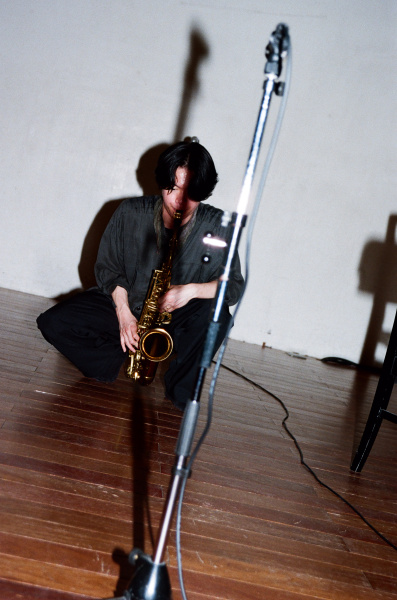
Shutsumin, the bracing debut album from the duo of Otomo Yoshihide and Kei Matsumaru, is a collaboration spanning generations and approaches. Recorded live at Tokyo’s Pit Inn in April of 2024, the album captures improvised music of brain-frying intensity and rawness, carving out a zone where the boundary between noise and free jazz is kicked to the curb.
Yoshihide, of course, is one of the most influential, fearless, and versatile experimentalists in modern Japan, a committed improviser who has nonchalantly straddled stylistic divides as a turntablist and guitarist. Although free jazz was one of his earliest inspirations, his earliest work was more connected to Japan’s thriving noise scene, and while he’s been working with jazz projects for decades, it’s only years that his deep love for jazz has come to the fore thanks to his long-running quintet and his ebullient, playful big band. In his own practice he nonchalantly blurs any lines between jazz and noise, embracing a fierce improvisational ethos that ties all of his disparate work together.
Matsumaru, some three-and-half decades younger than Otomo, is a relative newcomer to Japan’s creative music scene, moving to Tokyo after finishing his studies at the Berklee College of Music in Boston. He grew up in in a small village in the highlands of Papua New Guinea, where he taught himself to play saxophone.
At Berklee he first heard the music of Ornette Coleman, which dramatically opened up his world, and since arriving in Tokyo in 2018 his work has grown exponentially. In addition working with the likes of Eiko Ishibashi, Jim O’Rourke, Tatsuhisa Yamamoto, Kazuhisa Uchihashi, and Koichi Makigami, his own projects have embraced post-bop, electronics music, and even art-pop. He plays on Ishibashi’s acclaimed 2025 album Antigone and he’s become part of her touring band.
Yoshihide was impressed by Matsumaru’s first album Nothing Unspoken Under the Sun (2020), and soon invited him to work together, an ongoing collaboration that has taken numerous forms, including performances of music by the legendary Japanese composer Toru Takemitsu. Their work as a duo embraces free improvisation as a driving force, eliminating any distinction between free jazz and noise.
The music contained on Shutsumin reveals an instinctive connection, with both musicians tapping deep into an almost primordial energy, and while their astonishing collective skills couldn’t be more obvious, the work they’ve created transcends techniques, a fine balance between the gut and the brain. In a 2023 interview for Tone Glow, Yoshihide explained one of his aesthetic principles, the idea of multilingualism:
“Playing a bunch of different genres doesn’t mean you’re ‘multilingual,’ it’s more like you’re dreaming about it, like someone in the rural countryside might dream of the city. When I hear these younger musicians, they’re not even trying, it’s just who they are. Playing with them is really fun,” he said, citing Matsumaru as one such figure. There’s no missing that aim in these visceral improvisations.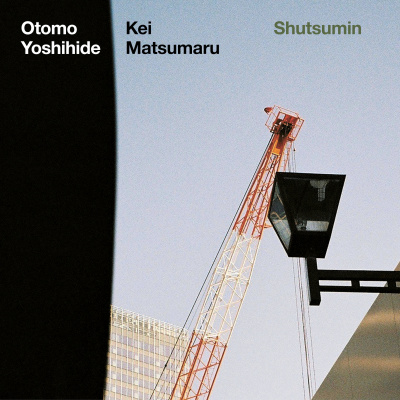
https://www.keimatsumaru.com
Yoshihide, of course, is one of the most influential, fearless, and versatile experimentalists in modern Japan, a committed improviser who has nonchalantly straddled stylistic divides as a turntablist and guitarist. Although free jazz was one of his earliest inspirations, his earliest work was more connected to Japan’s thriving noise scene, and while he’s been working with jazz projects for decades, it’s only years that his deep love for jazz has come to the fore thanks to his long-running quintet and his ebullient, playful big band. In his own practice he nonchalantly blurs any lines between jazz and noise, embracing a fierce improvisational ethos that ties all of his disparate work together.
Matsumaru, some three-and-half decades younger than Otomo, is a relative newcomer to Japan’s creative music scene, moving to Tokyo after finishing his studies at the Berklee College of Music in Boston. He grew up in in a small village in the highlands of Papua New Guinea, where he taught himself to play saxophone.
At Berklee he first heard the music of Ornette Coleman, which dramatically opened up his world, and since arriving in Tokyo in 2018 his work has grown exponentially. In addition working with the likes of Eiko Ishibashi, Jim O’Rourke, Tatsuhisa Yamamoto, Kazuhisa Uchihashi, and Koichi Makigami, his own projects have embraced post-bop, electronics music, and even art-pop. He plays on Ishibashi’s acclaimed 2025 album Antigone and he’s become part of her touring band.
Yoshihide was impressed by Matsumaru’s first album Nothing Unspoken Under the Sun (2020), and soon invited him to work together, an ongoing collaboration that has taken numerous forms, including performances of music by the legendary Japanese composer Toru Takemitsu. Their work as a duo embraces free improvisation as a driving force, eliminating any distinction between free jazz and noise.
The music contained on Shutsumin reveals an instinctive connection, with both musicians tapping deep into an almost primordial energy, and while their astonishing collective skills couldn’t be more obvious, the work they’ve created transcends techniques, a fine balance between the gut and the brain. In a 2023 interview for Tone Glow, Yoshihide explained one of his aesthetic principles, the idea of multilingualism:
“Playing a bunch of different genres doesn’t mean you’re ‘multilingual,’ it’s more like you’re dreaming about it, like someone in the rural countryside might dream of the city. When I hear these younger musicians, they’re not even trying, it’s just who they are. Playing with them is really fun,” he said, citing Matsumaru as one such figure. There’s no missing that aim in these visceral improvisations.
RELEASES
LINKS
https://otomoyoshihide.com/https://www.keimatsumaru.com


